
Reviewed · MUSEUMS
Gyeongju UNESCO Sites Tour by KTX train; The Museum Without walls
A Silla day trip without the hassle. This tour strings together major UNESCO heritage stops in Gyeongju, with round-trip KTX and a guide in English so you spend your day looking at sites instead of solving logistics. I especially like the tight, one-hour-per-stop rhythm (so you don’t feel stuck at one place too long) and the fact that admissions are handled for you along the way.
The main thing to consider is the schedule: it’s a long day (about 8 to 9 hours) with several outdoor viewpoints, so rain or cold weather can make the walking feel heavier than you expect.
In This Review
- Quick hits before you go
- Gyeongju as a Museum Without Walls: what you really see
- Seoul to Gyeongju by KTX: early start, smooth handoffs
- Cheonmachong Tomb: Silla power in burial mounds
- Gyeongju National Museum: the context stop that saves your brain
- Cheomseongdae Observatory: the star tower from 634
- Donggung Palace and Wolji (Anapji) Pond: court life and reflections
- Bulguksa Temple: where Silla Buddhism shows its skills
- Seokguram: the grotto above the East Sea
- Guide and pacing: how the day stays stress-free
- Price and value: is $470 worth it?
- What to pack and how to handle a day full of monuments
- Should you book this Gyeongju UNESCO day trip?
- FAQ
- What time does the tour start?
- How long is the Gyeongju UNESCO Sites Tour?
- Is hotel pickup included from Seoul?
- Are admission tickets included?
- Does the tour include the KTX train tickets?
- Are meals included?
- Is this a private tour?
- Is free cancellation available?
Quick hits before you go
- KTX round trip included in economic class, so you don’t waste time buying or matching train tickets.
- Private transfers from Seoul (hotel pickup in Seoul areas, private vehicle) that reduce the usual scramble.
- UNESCO-focused Silla route across tombs, palace remains, a royal observatory, and two of the region’s most famous religious sites.
- Gyeongju National Museum context stop so the rest of the day makes more sense.
- Bulguksa + Seokguram pair: temples plus sculptures, with a dramatic setting overlooking the East Sea.
- English-speaking guides who have been known to help with the train boarding process and keep things organized.
A handful of other Seoul experiences to line up next
- Seoul: War Memorial of Korea Private Guided Museum Tour★ 4.9 · 29 reviews
- DMZ Tour + The War Memorial of Korea Museum★ 5.0 · 28 reviews
- Color Pool Museum★ 4.0 · 22 reviews
- SEOUL: Gugak – Korean Traditional Music Museum&Concert Tour★ 4.7 · 17 reviews
Gyeongju as a Museum Without Walls: what you really see
Gyeongju is one of those places where the past isn’t locked behind a single ticket window. It sprawls across tomb mounds, temple hillsides, palace ponds, and observatories—so the city often gets called a museum without walls. This tour takes that idea seriously and gives you a planned route through the most visit-worthy anchors of the Silla kingdom story.
You start with a burial landscape, then move into artifacts and interpretive context, then head into palace and astronomy remains, and finally end with Buddhist architecture and sculpture at Bulguksa and Seokguram. In other words, you’re not just collecting photos. You’re building a storyline: power (royal burials), learning and state craft (astronomy/palace life), and spiritual art (temples and grotto sculptures).
If you like history but also like not thinking too hard about logistics, this format is made for you.
Seoul to Gyeongju by KTX: early start, smooth handoffs
The tour kicks off at 7:00 am. That early departure matters because Gyeongju day trips live or die by time management. You’re trading a night in town for a single, concentrated day—and the only way that works is getting the train and transfers handled tightly.
Here’s what’s included on the transport side:
- Hotel pickup in Seoul areas by private vehicle
- Round-trip KTX fare (economic class)
- Private vehicle transfers around Gyeongju
You also get a mobile ticket and the booking confirms in advance. The overall vibe is “you show up, we move you.” That’s a big deal when you’re dealing with a KTX day schedule plus multiple sites.
One useful detail from past groups: some guides have helped with the in-between steps—like getting to the right spot for boarding and being there while you find your seats. If you’re the kind of traveler who gets nervous about transit during a tight day, that support can be worth its weight in gold.
Cheonmachong Tomb: Silla power in burial mounds
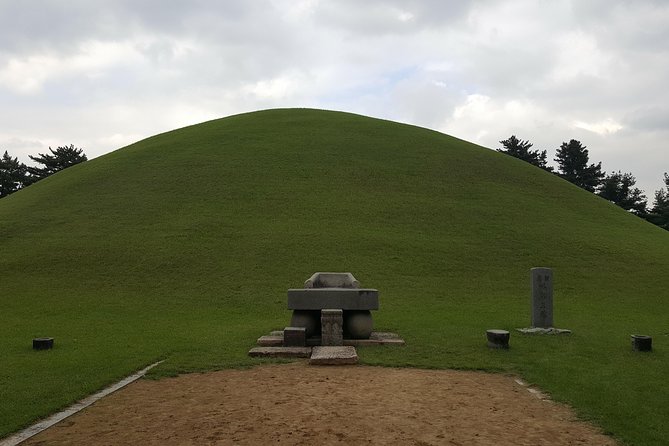
Your first stop is the Cheonmachong Tomb, part of the larger field of Silla-period tombs. This area is known for having more than 20 large and small tombs. Many are earthen and mound-shaped, and the larger ones are thought to be linked to kings and court officials.
This is a great opening stop because it teaches you how Silla society displayed authority. You start the day looking at how power was built into the landscape—literally rising above the earth in planned burial forms. Then, when you hit museum artifacts later, you’ll recognize the same themes showing up again.
Practical note: even with an hour here, plan on some walking over uneven ground paths. Bring shoes you trust.
Gyeongju National Museum: the context stop that saves your brain
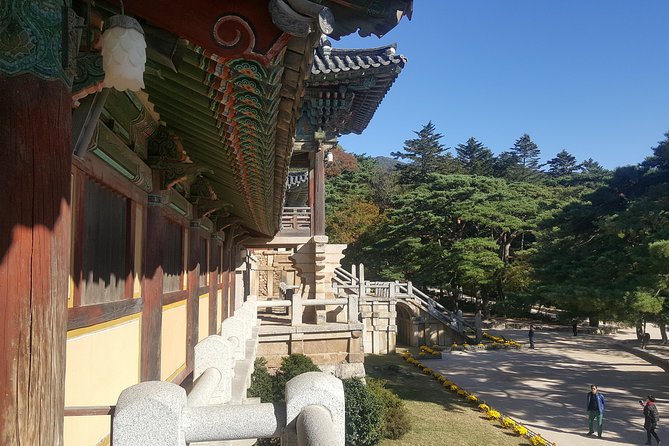
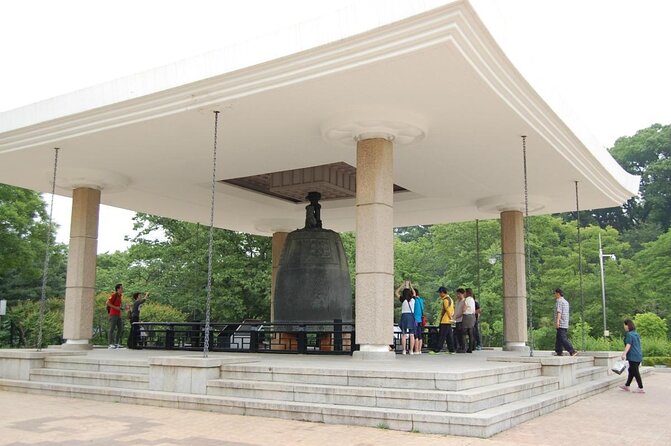
Next comes Gyeongju National Museum, and it’s not just a quick break. I like this stop because it acts like a decoder ring for the sites you’ll see afterward.
The museum’s main archaeological hall is built around showing why the ancient city mattered. You’ll see Silla-related objects and ceremonial pieces that help explain what you just heard about from the guide—and what you’ll keep encountering in temples and tombs.
The itinerary lists this as about 1 hour, and admissions are covered. You might even find that what looks like random remains outside clicks into place after you’ve seen the artifacts indoors.
If you want the day to feel more than a checklist, this museum is the difference-maker.
Cheomseongdae Observatory: the star tower from 634
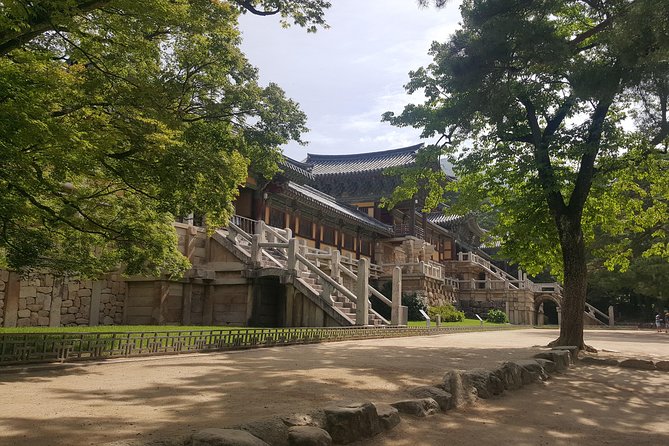
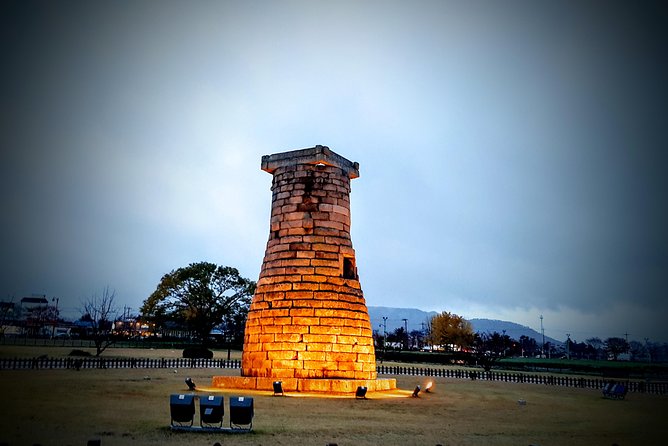
After the museum, you head to Cheomseongdae Observatory—known as the oldest existing observatory in the Far East. It was built in 634 during the reign of Queen Seonduk, the 27th ruler of the Silla dynasty.
The detail I’d pay attention to here is the structure: it’s described as having 27 levels of stones. That kind of design choice is exactly why guided interpretation helps. You’re not just seeing a tower; you’re seeing how the state treated observation and knowledge as something worth building into stone.
This stop is also about 1 hour, and admission is listed as free in the tour flow (even though the tour covers site fees overall). It’s one of the easiest places to appreciate Silla craftsmanship because the building is compact and clear.
Donggung Palace and Wolji (Anapji) Pond: court life and reflections
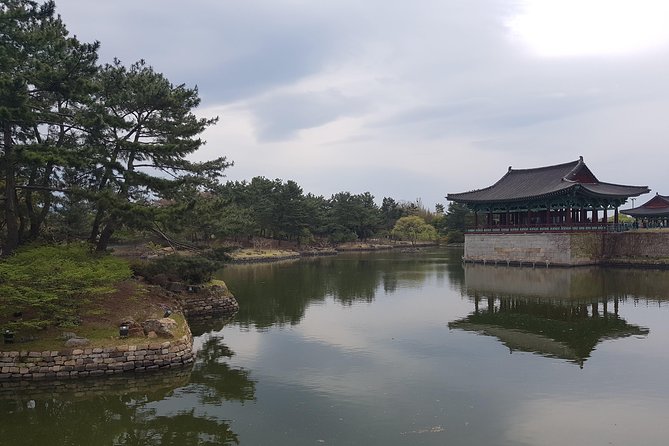
Then you move into the area of Donggung Palace and Wolji Pond—the tour commonly references it as Anapji Pond too. This palace-and-pond zone is closely tied to the Silla court, and the pond setting is where the remains feel most atmospheric.
The background given for the pond is that it was built after unification of the Korean Peninsula, in 674, and the palace walls were designed with small mountains inside, plus trees and flowers. Birds and animals were also part of the description, which is a reminder that this wasn’t only a functional water feature—it was a curated environment.
Expect some walking and open-air viewing. If the weather turns, this may be the first place where you’ll feel it, because you’re in a courtyard/pond landscape rather than sheltered galleries.
This stop is also set at about 1 hour, with the tour including site fees.
Bulguksa Temple: where Silla Buddhism shows its skills
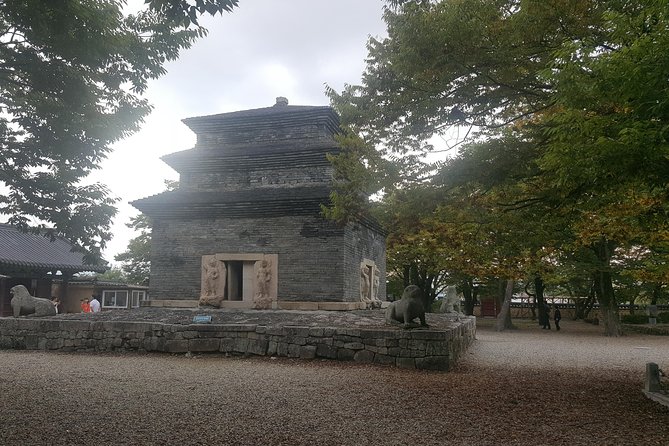
From palace pond to temple hill: the tour brings you to Bulguksa Temple, described as the most famous Buddhist temple in Korea and a key Silla relic site.
What you’re there for is specifically the important stone pagodas Dabotap and Seokgatap. Those names matter because they give you something concrete to look for instead of wandering through a large complex without anchors. This is where a guided approach helps you not miss the most meaningful works.
This stop runs about 1 hour and includes admission. Even if you’re not a hardcore temple person, Bulguksa is famous for a reason: the stonework and religious symbolism are easy to notice once you know what to target.
Seokguram: the grotto above the East Sea
Finally, you get to Seokguram, the hermitage grotto connected to Bulguksa. It’s set 750 meters above sea level and overlooks the East Sea, which is part of what makes it feel dramatic even before you start looking closely.
This site is known for some of the best Buddhist sculptures in the world (as described by the tour info). You’re not just visiting a “pretty cave.” You’re seeing major religious art in a location that was chosen for both spiritual and scenic impact.
You’ll have about 1 hour for this stop. It’s usually a calmer payoff at the end of a long day—one where your brain finally relaxes because the art and views do the work.
Guide and pacing: how the day stays stress-free
This is a private tour for your group, with an English-speaking guide included. The pacing is built around a simple unit: about 1 hour at each main stop. That structure is a big part of why people rate it highly.
From past experiences shared by people who’ve booked this style of tour, I’d highlight two things that tend to make it feel smooth:
- The team handles the “in-between” steps, like meeting you, escorting you through transit points, and making sure you’re ready for boarding when it’s time.
- Guides often bring the sites to life with clear explanations, so you understand what you’re looking at rather than just seeing stones and ruins.
One caution: not every English voice lands equally for every listener. There’s at least one account where the guide’s accent made it harder to catch every detail. If that’s your concern, it helps to go in with a basic willingness to ask for clarification.
Also: this tour doesn’t include meals. But guides sometimes suggest where to eat and give practical timing so you don’t lose your place. One guide, for example, was praised for steering people to a small lunch spot with generous portions.
Price and value: is $470 worth it?
At $470 per person, you’re paying for a lot of convenience, not just sightseeing. Here’s what your money is buying:
- KTX round trip (economic class)
- Private transfers in and around Seoul and Gyeongju
- Hotel pickup in Seoul areas
- Local English-speaking guide
- Admissions across the listed sites
- All-day organization across multiple major locations
If you were to do this independently, you’d probably need to coordinate train times, figure out how to move between sites efficiently, buy tickets for every stop, and still find a way to understand the Silla context fast enough for a one-day window. This tour saves you that coordination effort.
So when does it make sense?
- You want a high-effort day with minimal stress
- You care about Silla history and prefer a guided narrative
- You’d rather pay than spend your energy planning transport and entry tickets
When might it not be the best value?
- If you love traveling slowly or you’re okay with self-guided museum and temple hopping
- If you’re traveling with flexible time and can build a multi-day stay in Gyeongju (which can feel more relaxed than cramming everything into one route)
What to pack and how to handle a day full of monuments
Because this schedule includes multiple outdoor spaces (tomb mounds, palace pond areas, and temple grounds), pack for comfort more than fashion:
- Good walking shoes (the day is mostly walking between sites)
- Layers (Seoul-to-Gyeongju timing can mean a wide temperature swing)
- Weather protection (rain gear if forecasts look questionable)
- Water and snacks for gaps, since meals aren’t included
Also, plan your expectations: each stop is about 1 hour, so you’ll see the highlights—but you won’t have hours to wander off the path and second-guess every angle. If you’re the type who likes long museum time, the museum stop will feel “just right” for some travelers and “too short” for others.
Should you book this Gyeongju UNESCO day trip?
I’d book this tour if you want a structured, Silla-focused day that’s heavy on the important sites and light on planning. The combination of KTX rail, private transfers, an English-speaking guide, and admissions included makes it a strong choice for visitors who only have a single day between Seoul and Gyeongju.
Pass if your priority is slow travel, or if you know you won’t handle rain/outdoor walking well. The tour is designed for motion, not for lingering.
If you want your day to feel coherent—tombs leading into artifacts leading into palace and temple monuments—this route does that job.
FAQ
What time does the tour start?
It starts at 7:00 am.
How long is the Gyeongju UNESCO Sites Tour?
The duration is listed as 8 to 9 hours (approx.).
Is hotel pickup included from Seoul?
Yes. Hotel pickup (Seoul areas) is included, using a private vehicle for transfers.
Are admission tickets included?
Yes. All admission fees for the listed tourist sites are included.
Does the tour include the KTX train tickets?
Yes. The price includes round-trip KTX fare (economic class).
Are meals included?
No. Every meals is listed as not included.
Is this a private tour?
Yes. It’s described as a private tour/activity, meaning only your group participates.
Is free cancellation available?
Yes. You can cancel up to 24 hours in advance for a full refund. If you cancel later than that, the amount paid isn’t refunded.
More Museums in Seoul
- Seoul: War Memorial of Korea Private Guided Museum Tour★ 4.9 · 29 reviews
- DMZ Tour + The War Memorial of Korea Museum★ 5.0 · 28 reviews
- Color Pool Museum★ 4.0 · 22 reviews
- SEOUL: Gugak – Korean Traditional Music Museum&Concert Tour★ 4.7 · 17 reviews
- Seoul: National Museum of Korea Guided Tour★ 5.0 · 13 reviews
More Tours in Seoul
- Best DMZ Tour Korea from Seoul (Red Suspension Bridge Optional)★ 5.0 · 41,422 reviews
- DMZ Tour: 3rd Tunnel, Option(Suspension Bridge, Boat) from Seoul★ 5.0 · 21,373 reviews
- DMZ tour south Korea from Seoul (NK experience hall, defector)★ 5.0 · 20,599 reviews
- Seoul: DMZ Tour with Optional Suspension Bridge★ 4.8 · 5,277 reviews
- Seoul: DMZ The 3rd Tunnel and Suspension Bridge Tour★ 5.0 · 4,656 reviews
More Tour Reviews in Seoul
- Best DMZ Tour Korea from Seoul (Red Suspension Bridge Optional)★ 5.0 · 41,422 reviews
- DMZ Tour: 3rd Tunnel, Option(Suspension Bridge, Boat) from Seoul★ 5.0 · 21,373 reviews
- DMZ tour south Korea from Seoul (NK experience hall, defector)★ 5.0 · 20,599 reviews
- Seoul: DMZ Tour with Optional Suspension Bridge★ 4.8 · 5,277 reviews
- Seoul: DMZ The 3rd Tunnel and Suspension Bridge Tour★ 5.0 · 4,656 reviews
Just added to Exploring Seoul

Museums, compared.
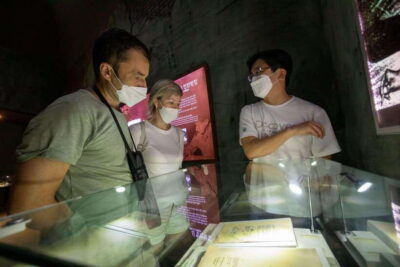 ★ 4.9War Memorial of Korea Private Guided Museum TourFrom $10029 reviews
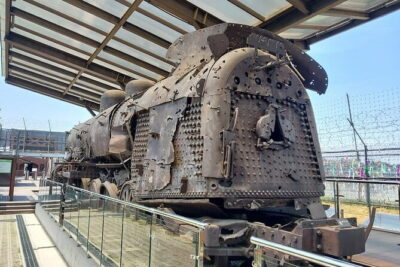 ★ 5.0DMZ Tour + The War Memorial of Korea MuseumFrom $6528 reviews
 ★ 4.0Color Pool MuseumFrom $1322 reviews
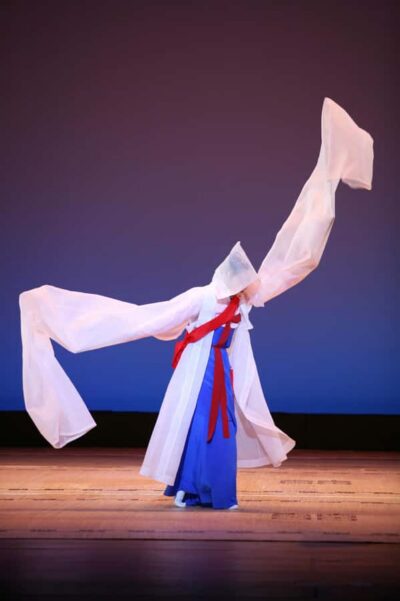 ★ 4.7SEOUL: Gugak – Korean Traditional Music Museum&Concert TourFrom $4917 reviews
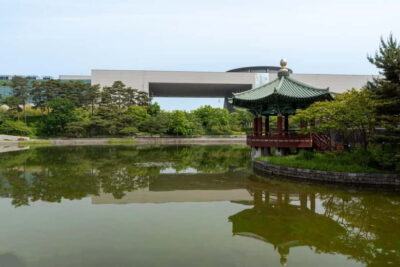 ★ 5.0National Museum of Korea Guided TourFrom $3813 reviews
 ★ 5.0Time Travel in Seoul: Gyeongbokgung, Folk Museum & BukchonFrom $5410 reviews
 ★ 4.8Layover tour to Gyeongbokgung-Folk Museum-Bukchon-InsadongFrom $2546 reviews
 ★ 5.0Time Travel in Seoul: Gyeongbokgung Palace, Folk Museum & BukchonFrom $576 reviews
Browse the lists this tour appears in