
North Korea feels real here, not movie-real. This DMZ-edge day trip heads to Aegibong for close, riverfront views, plus a famous stop at the nearest Starbucks to the border.
What I like most is how the day is built for sightlines, not just check-the-box history. You’ll spend real time in the Aegibong Peace Eco Park area and then finish with the 조강전망대 (Jogang Observatory) viewpoint where binoculars help you pick out villages across the border.
The main thing to consider: a big chunk of your day is time at Starbucks. If you’re chasing maximum border time over coffee time, build that expectation up front.
In This Review
- Key highlights you will care about
- Why Aegibong is the best North Korea-view day trip from Seoul
- Getting there and passing the Aegibong passport checkpoint
- Marine Corps Memorial: the history starts before the views
- Aegibong Peace Eco Park: the border-facing park that does more than photos
- The swing bridge and border photos: how to get the shot
- Peace bell, altar, and the softer side of the DMZ edge
- Starbucks Aegibong: closest latte, closest border
- 조강전망대 observatory: the payoff for your time on the river edge
- Price and time value: what you’re really paying for
- Who this DMZ-edge tour suits best
- Should you book this Aegibong DMZ-edge tour?
- FAQ
- Do I need a passport for this tour?
- Does this tour enter the DMZ?
- What are the main viewing spots for North Korea?
- Where do you pick up in Seoul?
- How long is the tour?
- Is coffee included at Starbucks?
- What’s included in the price?
- How many people are in the group?
- What time does the tour start?
Key highlights you will care about
- Aegibong border-edge views from South Korea along the Jogang River, with security screening at the ticket office using your passport
- One of Korea’s closest observatories to the DMZ at 조강전망대, with binoculars and villages reportedly about 1.4km away
- Peace stops that feel practical: memorials, a swing bridge for photos, a peace bell ritual, and an altar
- Starbucks Aegibong: a full hour for a latte right by the action, even though coffee is not included
- Tour guides with strong border-history storytelling (examples include Judy, Gogo, Hana, Alex, Gabby, Crystal, Alice, and Juno)
Other ways to reach the DMZ and the border from Seoul
- DMZ Tour: 3rd Tunnel, Option(Suspension Bridge, Boat) from Seoul★ 5.0 · 21,373 reviews
- DMZ tour south Korea from Seoul (NK experience hall, defector)★ 5.0 · 20,599 reviews
- Seoul: DMZ Tour with Optional Suspension Bridge★ 4.8 · 5,277 reviews
- Seoul: DMZ The 3rd Tunnel and Suspension Bridge Tour★ 5.0 · 4,656 reviews
Why Aegibong is the best North Korea-view day trip from Seoul
If you want North Korea views that feel close enough to matter, Aegibong is one of the most direct ways to get them without crossing into the DMZ. The key detail is that you do not enter the DMZ, but you do go to the edge along the Jogang River, which forms part of the DMZ line near Aegibong. That combination matters: you get that border feeling with less red tape than a full DMZ visit.
The other reason this tour works is the structure. The day isn’t just bus-to-viewpoint. You move through several themed stops tied to the same border-facing zone: memorials, peace parks, a swing bridge designed for photos, and then the observatory. By the time you reach 조강전망대, you’re not seeing it in a vacuum—you already understand what you’re looking at and why it’s there.
And yes, there’s that Starbucks factor. The Aegibong branch has gotten global attention as a symbol of security and as a rare way to look into North Korea without crossing the border. Even if you’re not a coffee person, it’s a memorable, very “you’re here” stop.
Getting there and passing the Aegibong passport checkpoint
This tour runs about 5 hours and uses a mobile ticket. Your day starts with pick-ups around central Seoul, including Myeongdong, Seoul City Hall, and Hongdae, plus the tour’s listed meeting at Hongik Univ. Station Exit 3 (and it ends in Hongdae).
Bring your passport. Not as a “just in case” item—this tour requires it for the security area at the Aegibong ticket office, which is where you’ll show your passport to pass through.
A practical note: plan for some waiting and slow-moving checkpoints. The ticket-office stop is brief (about 10 minutes), but it’s still the kind of place where the group pace follows the security line, not the clock on your wrist.
Also, keep an eye on weather and wind. One guide’s experience included a scenario where the bridge could close due to weather, turning your swing-bridge segment into a hill climb. That’s not guaranteed, but it’s enough that you should dress like you might walk more than you expect.
Marine Corps Memorial: the history starts before the views
Your first major “meaning stop” is the Marine Corps Memorial. It’s about 20 minutes, and it sets the emotional tone. The memorial recognizes Marines who fought in the Korean War, and it’s built to make the war’s human cost feel less abstract—especially when you’re about to look at the same border that still carries that legacy.
This is also where your guide’s style really matters. Multiple guides praised for history storytelling (names that come up include Judy, Gogo, Alex, Crystal, Alice, and Juno) tend to do the same helpful thing: they connect the present-day geography to why the DMZ exists and why this particular area matters.
If you learn best by context, don’t skip your guide’s short briefing here. The rest of the day moves fast.
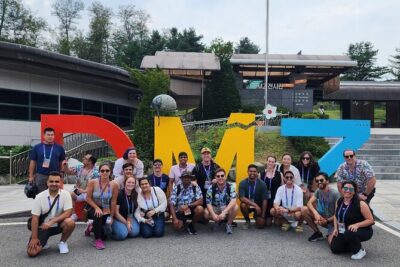
Aegibong Peace Eco Park: the border-facing park that does more than photos
Next comes the heart of the Aegibong area: Aegibong Peace Eco Park for about 1 hour. This is where you get the “walkable viewpoints” feel. The park faces the DMZ side and mixes greenery with war relics, turning it into a living reminder that the border is not just a line on a map.
For many people, the value here isn’t that every inch is dramatic. It’s that you can take your time, look in different directions, and absorb the fact that North Korea is not miles away in a theoretical sense—it’s visible from a place you can walk.
Then you continue to another Peace Ecological Park segment for about 30 minutes, with themes and a Sky Forest canopy area. The canopy detail is useful because it changes your viewing angle and gives you a different way to frame the border.
The tricky part: parks in this zone can mean uneven ground and stairs. Wear comfortable shoes. You’ll be moving a lot for a day that sounds “easy” on paper.
The swing bridge and border photos: how to get the shot
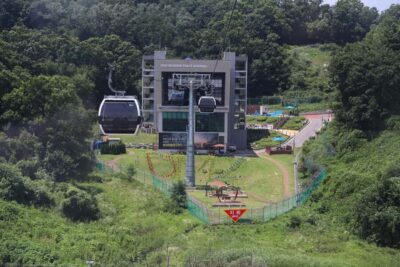
There’s a reason the 150m swing bridge shows up as a highlight: it’s built for thrill and for angles. It’s about 30 minutes at the stop, and it’s one of those places where you’ll see people doing the same thing—taking border-facing photos from a spot that feels like it’s hovering over the line.
If you’re the cautious type, that’s fine. The bridge is still worth it for the viewpoints even without extreme photo energy. But you should plan for the real possibility of weather-related closure. One guide’s experience described a plan shift if the bridge closes, leading to more walking uphill. So if you’d rather not deal with an unexpected hike, keep your footwear and energy level in mind.
Also, bring patience. This is a photo stop. The group pace will slow when people line up and when weather affects how long it takes to cross.
Peace bell, altar, and the softer side of the DMZ edge
After the parks and bridge segment, the itinerary shifts to ritual and reflection. You’ll have time at:
- An outdoor performance stage area (about 20 minutes), where timing can affect whether you catch cultural or modern performances while you sit with the Jogang River views.
- The 애기봉 평화의종 (Peace Bell) (about 15 minutes). The bell cast in 2000 symbolizes hopes for reunification, and it’s treated like a must-do ritual moment.
- A short reflective stop at an altar area (about 10 minutes) built in 2018.
These stops might sound “small” compared with the big view moments, but they’re valuable because they slow the day down. They also help you frame what you’re seeing. Without them, you could leave feeling like you only watched a border. With them, you leave thinking about the people and the meaning behind the fence line.
Starbucks Aegibong: closest latte, closest border
Now for the part that sparks debate: Starbucks. You get about 1 hour here, and it’s positioned as the closest Starbucks to North Korea. Coffee itself is not included, so you’re paying for the latte (or tea), but you’re getting a full hour to sit, order, and watch the border.
This is where the tour’s marketing edge shows. The Aegibong branch has been described as a symbol of security, and the broader point is that it’s one of the few ways to look inside North Korea without crossing the border. Even if you take a minimalist approach to the “capitalism symbol” conversation, it’s still a striking setting.
One more balanced tip: because the Starbucks time is fixed, your best “views-first” strategy is simple. If you want the best lookout time, give yourself a few minutes right when you arrive to scan the view before you order. Then settle in. You’ll get both the coffee break and the border moment.
조강전망대 observatory: the payoff for your time on the river edge
The final big visual payoff is 조강전망대 (Jogang Observatory). This segment is about 30 minutes, and it’s framed as Korea’s closest observatory to the DMZ.
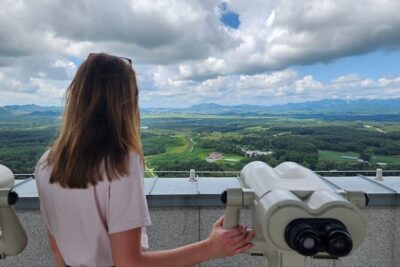
The important detail here is binocular viewing. The binoculars can reveal villages reportedly around 1.4km away, which is the kind of specific claim that helps you understand why this stop matters. You’re not just staring at a distant horizon; you have tools and a location chosen for close sightlines.
Because time is limited, do this:
- Stand where your guide tells you to stand (they’ll account for group movement and best angles)
- Use the binoculars quickly at least once, then decide if you want a second look
- Take a few photos, then watch without the camera for a minute or two—your eyes often spot shapes the camera doesn’t catch
Price and time value: what you’re really paying for
At $49 per person with round-trip transportation, a guide, and entrance fees, this tour can feel like a bargain compared with longer DMZ-style days. But the value question depends on what you want.
You’re paying for:
- Coordinated bus transport from central Seoul
- The guide’s history framing (and yes, some guides—like Gogo and Judy—stand out for clear explanations and humor)
- Access to the Aegibong area’s planned stops, including ticketed segments
- A full hour at the closest Starbucks stop plus a final observatory segment
You’re not paying for:
- Meals
- Coffee or tea
- An actual DMZ entry
So if your top priority is maximum time staring at the border, you may feel the Starbucks hour is a lot. If your priority is “a tight day with strong context and the best view sequence available from Seoul,” it’s easier to justify.
Also remember this tour caps at 100 travelers. That usually helps it feel less chaotic than a huge group day.
Who this DMZ-edge tour suits best
This is a strong fit if you:
- Want the best North Korea viewing options from Seoul without entering the DMZ
- Like guided history that connects borders to real events
- Prefer a day that’s mostly planned stops with short durations instead of a long, complicated schedule
- Want an iconic stop that you can actually experience, not just read about
It’s less ideal if you:
- Want minimal time at Starbucks and maximum time at viewpoints
- Are highly sensitive to weather-driven changes (the swing bridge can potentially be affected)
- Hate the idea of security checks with passport requirements
Should you book this Aegibong DMZ-edge tour?
If you’re trying to choose between “see the border for a moment” and “see the border with context,” I’d lean toward booking. The Aegibong layout is designed for sightlines, and the final 조강전망대 observatory stop is where the whole day clicks into place.
I would book it especially if you value structure and guidance. The guide names that show up repeatedly—Judy, Gogo, Hana, Alex, Gabby, Crystal, Alice, and Juno—suggest consistent strengths: explaining why this border exists and keeping the tone clear and human, not stiff.
Just go in with eyes open about the trade-off: you’ll spend a real hour at Starbucks. If that sounds like a deal-breaker, look for a different DMZ-style option. If it sounds like a memorable, once-in-a-lifetime setting where you can combine coffee and border views, this tour is a smart pick for a half-day plan.
FAQ
Do I need a passport for this tour?
Yes. You must show your passport at the Aegibong ticket office security area. The tour data specifically notes you cannot enter without a passport.
Does this tour enter the DMZ?
No. It does not technically enter the DMZ. It goes right up to the edge along the Jogang River near Aegibong for viewing.
What are the main viewing spots for North Korea?
The tour includes the Aegibong-area parks and ends with the 조강전망대 (Jogang Observatory), which is described as the closest observatory to the DMZ and uses binoculars to help you see villages.
Where do you pick up in Seoul?
Pick-ups include Myeongdong Subway Station Exit 9, Seoul City Hall Subway Station Exit 6, and Hongdae Subway Station Exit 3. The listed meeting point is Hongik Univ. Station Exit 3.
How long is the tour?
It runs for about 5 hours (approx.).
Is coffee included at Starbucks?
No. Coffee and/or tea are listed as not included. You can buy your own drink during the Starbucks stop.
What’s included in the price?
The price includes a tour guide (English or Chinese), round-trip transportation, and entrance fees.
How many people are in the group?
The tour has a maximum of 100 travelers.
What time does the tour start?
The listed start time is 9:00 am.
More Tours in Seoul
- Best DMZ Tour Korea from Seoul (Red Suspension Bridge Optional)★ 5.0 · 41,422 reviews
- DMZ Tour: 3rd Tunnel, Option(Suspension Bridge, Boat) from Seoul★ 5.0 · 21,373 reviews
- DMZ tour south Korea from Seoul (NK experience hall, defector)★ 5.0 · 20,599 reviews
- Seoul: DMZ Tour with Optional Suspension Bridge★ 4.8 · 5,277 reviews
- Seoul: DMZ The 3rd Tunnel and Suspension Bridge Tour★ 5.0 · 4,656 reviews
More Tour Reviews in Seoul
- Best DMZ Tour Korea from Seoul (Red Suspension Bridge Optional)★ 5.0 · 41,422 reviews
- DMZ Tour: 3rd Tunnel, Option(Suspension Bridge, Boat) from Seoul★ 5.0 · 21,373 reviews
- DMZ tour south Korea from Seoul (NK experience hall, defector)★ 5.0 · 20,599 reviews
- Seoul: DMZ Tour with Optional Suspension Bridge★ 4.8 · 5,277 reviews
- Seoul: DMZ The 3rd Tunnel and Suspension Bridge Tour★ 5.0 · 4,656 reviews
The DMZ & the Border, More Routes
- Best DMZ Tour Korea from Seoul (Red Suspension Bridge Optional)★ 5.0 · 41,422 reviews
- DMZ Tour: 3rd Tunnel, Option(Suspension Bridge, Boat) from Seoul★ 5.0 · 21,373 reviews
- DMZ tour south Korea from Seoul (NK experience hall, defector)★ 5.0 · 20,599 reviews
- Seoul: DMZ Tour with Optional Suspension Bridge★ 4.8 · 5,277 reviews
- Seoul: DMZ The 3rd Tunnel and Suspension Bridge Tour★ 5.0 · 4,656 reviews
Just added to Exploring Seoul

DMZ Day Tours, compared.
 ★ 5.0DMZ Tour: 3rd Tunnel, Option(Suspension Bridge, Boat) from SeoulFrom $3521,373 reviews
 ★ 5.0DMZ tour south Korea from Seoul (NK experience hall, defector)From $2620,599 reviews
 ★ 4.8DMZ Tour with Optional Suspension BridgeFrom $455,277 reviews
 ★ 5.0DMZ The 3rd Tunnel and Suspension Bridge TourFrom $654,656 reviews
 ★ 5.0Signature DMZ Tour: Exclusive Defector Talk & Suspension BridgeFrom $274,459 reviews
 ★ 5.0Thrilling Korean DMZ 3rd Tunnel Tour from Seoul + Red Bridge RushFrom $353,097 reviews
 ★ 4.9DMZ Tour & Suspension Bridge (Option English/Spanish)From $352,628 reviews
 ★ 5.0DMZ Past and Present: Korean Demilitarized Zone Tour from SeoulFrom $372,481 reviews
Browse the lists this tour appears in