Seoul’s palaces make more sense on a bike. This Joseon-era ride pairs landmark stops with the backstreets locals actually use, so history feels close instead of museum-dry. You’ll roll through palace gates, old city routes, and café-lined alleys while your guide puts the stories in plain language.
I especially love how small-group pacing keeps the ride calm and conversational, and how the tour mixes major sites like Gyeongbokgung with quieter stretches like Deoksugung Doldam-gil. One thing to consider: you do need moderate comfort on a bicycle, and the food included is snacks rather than a full dinner.
In This Review
- Key highlights to know before you go
- Entering Joseon Seoul the Easy Way: By Bike, Not Bus
- Meeting point, group size, and how the ride stays comfortable
- Stop-by-stop: Cheonggyecheon to Jongno, and what each place teaches
- Cheonggyecheon Stream: the capital’s chosen water
- Seoul City Hall: from modern power to dynasty logic
- Deoksugung: where the Joseon era turns into an ending
- Deoksugung Doldam-gil: the stone-wall street with seasonal clues
- Jung-dong: early western churches at the edge of Joseon
- Gyeonghuigung Palace: a king’s story shaped by fear and survival
- Gwanghwamun Square: power, portraits, and two major historical figures
- Gyeongbokgung Palace: the big gates that teach you where to look
- Samcheongdong-gil Road: history, plus the daily Seoul you’ll actually want to revisit
- Jongno 3 Stalls Alley: the ride’s relaxed finish, with food in your head
- Included snacks and timing: what you get (and what you don’t)
- Price and value for $76.99: a bike-led history loop that’s not trying to do everything
- Who should book this Joseon bike tour
- Should you book this tour?
- FAQ
- How long is the bike tour?
- How much does the tour cost?
- What time does the tour start?
- Where do I meet for the tour?
- Is the tour free for palace entrances?
- What’s included in the price?
- Is dinner included?
- How many people are in the group?
- What if the weather is bad?
- Do I need an actual ticket printout?
Key highlights to know before you go
- Joseon-era storytelling that connects palaces to everyday life, not just dates and names
- Safety gear included: helmets and bike lights, plus bottled water
- Free-admission stops for the main sights, which helps your money go farther
- Gentle, easy-going route in a compact 3-hour loop (max 8 people)
- Street-food snacks like hotteok, fish-shaped red bean pastries, or Korean corn-dog
- Local lanes such as Samcheongdong-gil and Jongno 3 Stalls Alley alongside the big palace squares
Two wheels through more of Seoul
- Seoul E-bike Tour★ 5.0 · 536 reviews
- Alpaca World and Nami Island with Gangchon Rail Bike Tour★ 5.0 · 138 reviews
- Morning Bike Tour along the Han River with a Local★ 5.0 · 71 reviews
- Afternoon E-bike tour and “Happy Hour” food and drinks★ 5.0 · 46 reviews
Entering Joseon Seoul the Easy Way: By Bike, Not Bus
I like tours that help you read a city like it’s a living place. This one does that by riding through central Seoul and using the Joseon Dynasty as the thread. Instead of hopping between far-flung attractions, you get a logical line of sights that feels like an old route still visible under today’s skyline.
The big win here is the balance. You’re not only at palaces with postcard views; you’re also in small streets where the city’s daily rhythms show up. It’s the kind of approach that makes “Seoul is a city of palaces” feel practical, not just promotional.
Meeting point, group size, and how the ride stays comfortable
You’ll meet at 123 Euljiro 2(i)-ga, Jung District and the tour ends back at the same starting point. The route is designed around a short, satisfying 3-hour ride, and the group size stays small with a maximum of 8 travelers. That matters, because tight groups mean fewer waits at corners and easier conversation with your guide.
Bikes are provided, and so are the basics that make riding at dusk feel less stressful: helmets and lights. There’s also bottled water. The vibe from the ride-style described is relaxed and not strenuous, which is a good match if you want to enjoy Seoul’s streets without working up a sweat.
One note from the setup: you should have at least a moderate fitness level. If you’re very unsteady on a bike, this might be harder than it sounds, even if the pace is gentle.
Stop-by-stop: Cheonggyecheon to Jongno, and what each place teaches
This route is built like a timeline you can feel with your legs. Each stop is short, and the guide keeps it moving with stories you can connect from place to place.
A handful of other Seoul experiences to line up next
Cheonggyecheon Stream: the capital’s chosen water
The ride begins near Cheonggyecheon Stream, with a strong focus on how Korean ancestors thought about feng shui. Water wasn’t just scenery here; it was part of how the capital was imagined and organized.
You’ll also get a sense that the stream’s look changed over time. The tour frames it as something surprisingly different before the 1960s, which helps you understand why modern Seoul can feel layered: you’re seeing today’s canal line, but hearing how it was shaped by earlier realities.
Practical tip: bring your eyes for details at the edges of the waterway—this is one of those places where the setting tells half the story.
Seoul City Hall: from modern power to dynasty logic
Next is Seoul City Hall, approached with a question about where rich and powerful people live now—followed by the twist of thinking one dynasty earlier. In other words, you’re not learning facts in isolation; you’re learning how power moved in space and why people cared.
This stop is brief, but it helps reset your thinking. You come in expecting a government building and leave understanding it as a modern marker over earlier patterns of central Seoul.
Deoksugung: where the Joseon era turns into an ending
At Deoksugung, the story takes a more emotional turn. The tour talks about the end of Joseon and highlights the fact that the last king lived there. That context changes how you view the palace grounds: it’s not only impressive architecture; it’s a place tied to transition and loss.
The time spent here is around ten minutes, so you’re not expected to wander like you would solo. Instead, you’re given the narrative frame and then shown the vibe of the site so it sticks.
Deoksugung Doldam-gil: the stone-wall street with seasonal clues
Right after Deoksugung comes Deoksugung Doldam-gil, a stone-wall street the tour points out for what it feels like across seasons. You’ll hear how it can look and change from cherry blossoms to summer greens to autumn leaves.
The fun part is that the tour isn’t only visual. It includes a city legend tied to the area, which gives you something memorable to carry forward as you pedal again.
Watch-your-step note: the terrain here can be uneven like many older Seoul lanes. Keep an eye on the bike path edges and let your guide set the pace.
Jung-dong: early western churches at the edge of Joseon
In Jung-dong, the tour shifts from royal power to cultural contact. The focus is on churches and cathedrals, including mention of early western churches from the enlightenment movement near the end of Joseon.
This is a great stop if you like history that travels beyond palaces. It shows how late-Joseon Korea didn’t only change through internal palace politics—it also shifted through new ideas arriving from outside.
Gyeonghuigung Palace: a king’s story shaped by fear and survival
At Gyeonghuigung Palace, you’ll get a story-based framing: what it feels like to be left alone in Seoul at age 18. That’s tied to Gwanghae-gun, the king discussed here, including how he handled the Japanese invasion in the late 1500s and later became king.
The tour also hints at personal insecurity linked to origin—so it’s not presented as a simple hero narrative. That nuance makes the palace feel more human.
If palaces sometimes feel like empty stages to you, this kind of story makes the space feel occupied.
Gwanghwamun Square: power, portraits, and two major historical figures
Then you roll into Gwanghwamun Square, treated as a former power center. The guide asks who you might see here, then connects the square to two of Korea’s most respected historical figures.
Even if you’ve visited the square before, hearing it from a dynasty-era perspective changes the meaning. You start to see it as a hub where authority was displayed, not just a modern city landmark.
Gyeongbokgung Palace: the big gates that teach you where to look
At Gyeongbokgung Palace, the tour leans into architecture and scale. It suggests that just pausing at palace entrances helps you feel the energy of the era and notice design choices from about 600 years ago.
This stop is a short ten minutes, but it’s timed well within the loop. You’re fresh enough to appreciate the visuals, and the guide’s framing makes it easier to notice more than just the main gate.
Samcheongdong-gil Road: history, plus the daily Seoul you’ll actually want to revisit
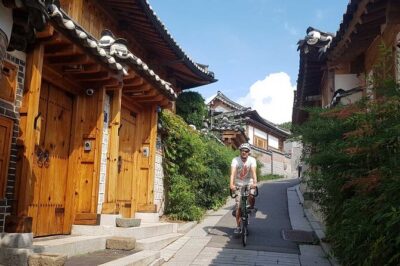
After the major palace energy, the tour moves toward Samcheongdong-gil Road, where it explicitly asks: you’re here for history, but also for how locals hang out. You’ll ride through small alleys lined with cafés, boutiques, and restaurants.
This is one of my favorite types of stops because it helps you build your own plan afterward. You can treat this stretch like a sampler, then come back on foot for the parts you liked most.
Practical tip: if you see a café you like, jot down the name or stop at the next practical moment. The bike portion moves on quickly.
Jongno 3 Stalls Alley: the ride’s relaxed finish, with food in your head
The last stop is Jongno 3 Stalls Alley, positioned for conversation and rest. The tour notes that there will be plenty of talking and time to admire the locations.
If the weather is bad, the tour can replace this part with a walking tour. That’s helpful because it keeps the experience from turning into a wet, slippery slog.
This final stretch also matches the included snack vibe: you end with local Seoul energy, not just a final photo by a big landmark.
Included snacks and timing: what you get (and what you don’t)
The tour includes one snack, plus bottled water. The snack options listed include hotteok, a fish-shaped red bean pastry, or a Korean corn-dog—the kind of choices that are easy to eat while you’re still moving.
You’ll also see that the included sites cover free admissions, which helps keep overall value strong. Even with a paid guide and bike use, the cost doesn’t spike because you’re not paying entrance fees at each stop.
That said, this is still a snack, not dinner. If you’re arriving hungry, you may want a light meal before you go or plan to eat after. One review also pointed out that the food market time felt shorter than expected—so if you want a bigger food crawl, you might need to add your own time outside the tour.
Price and value for $76.99: a bike-led history loop that’s not trying to do everything
At $76.99 per person for about three hours, you’re paying for three things: a guide, bike support, and the experience design that ties palace landmarks to nearby street life. The small group size (up to eight) helps justify that cost because it supports a calmer ride and more direct guidance.
You’re not just getting a map. You’re getting stop-by-stop interpretation—plus gear that makes night riding more comfortable thanks to helmets and lights. That safety detail is one reason this feels like more than a casual rental-bikeway.
Booking is typically done about 26 days in advance, which tells me it’s popular enough that you shouldn’t wait until the last minute if your dates are fixed. The tour uses a mobile ticket, which makes it easier to manage without paper.
Who should book this Joseon bike tour
This is a strong match if you want:
- A gentle, two-wheel way to cover central Seoul without sitting in traffic
- Palace sights plus nearby streets where you can keep exploring later
- A guide who can explain why the Joseon era matters for how Seoul works today
- A small group feel, with time for questions and conversation
It may be a weaker match if:
- You dislike riding bikes, even at a relaxed pace
- You want a full meal or a long food market visit (snacks are included, dinner is not)
- Your weather window is unstable, since the tour requires good weather and can shift to walking if needed
Should you book this tour?
I’d book it if your ideal Seoul day is a mix of major landmarks and side streets, and you like learning stories you can use when you walk around later. The combination of small-group riding, safety gear, and short stop pacing makes it feel easy to enjoy—even when you’re trying to see a lot.
Skip it if your plan is heavy on slow museum time or if you’re not comfortable biking. In that case, you’ll likely prefer a walking tour route instead.
If you’re balancing first-time sightseeing with an appetite for local snacks and alleyways, this is one of the better ways to get your bearings fast—without turning the day into a checklist.
FAQ
How long is the bike tour?
It runs about 3 hours.
How much does the tour cost?
The price is $76.99 per person.
What time does the tour start?
The start time listed is 10:00 am.
Where do I meet for the tour?
You’ll meet at 123 Euljiro 2(i)-ga, Jung District, Seoul, South Korea.
Is the tour free for palace entrances?
The listed stops note free admission ticket access for the experience’s stops.
What’s included in the price?
You get a bicycle, a local snack, bottled water, safety equipment (helmets and lights), and an in-person English guide.
Is dinner included?
No. Dinner is not included.
How many people are in the group?
The tour has a maximum of 8 travelers.
What if the weather is bad?
The tour requires good weather. If it’s canceled due to poor weather, you’ll be offered a different date or a full refund, and the route can be replaced by a walking tour in bad weather conditions.
Do I need an actual ticket printout?
No. The tour uses a mobile ticket, and confirmation is received at booking unless you book within 2 days, in which case confirmation arrives within 48 hours (subject to availability).
More Tours in Seoul
- Best DMZ Tour Korea from Seoul (Red Suspension Bridge Optional)★ 5.0 · 41,422 reviews
- DMZ Tour: 3rd Tunnel, Option(Suspension Bridge, Boat) from Seoul★ 5.0 · 21,373 reviews
- DMZ tour south Korea from Seoul (NK experience hall, defector)★ 5.0 · 20,599 reviews
- Seoul: DMZ Tour with Optional Suspension Bridge★ 4.8 · 5,277 reviews
- Seoul: DMZ The 3rd Tunnel and Suspension Bridge Tour★ 5.0 · 4,656 reviews
More Tour Reviews in Seoul
- Best DMZ Tour Korea from Seoul (Red Suspension Bridge Optional)★ 5.0 · 41,422 reviews
- DMZ Tour: 3rd Tunnel, Option(Suspension Bridge, Boat) from Seoul★ 5.0 · 21,373 reviews
- DMZ tour south Korea from Seoul (NK experience hall, defector)★ 5.0 · 20,599 reviews
- Seoul: DMZ Tour with Optional Suspension Bridge★ 4.8 · 5,277 reviews
- Seoul: DMZ The 3rd Tunnel and Suspension Bridge Tour★ 5.0 · 4,656 reviews
More of Seoul on Two Wheels
- Seoul E-bike Tour★ 5.0 · 536 reviews
- Seoul: City Highlights eBike Tour★ 4.9 · 168 reviews
- Alpaca World and Nami Island with Gangchon Rail Bike Tour★ 5.0 · 138 reviews
- Morning Bike Tour along the Han River with a Local★ 5.0 · 71 reviews
- Afternoon E-bike tour and “Happy Hour” food and drinks★ 5.0 · 46 reviews
Just added to Exploring Seoul
Cycling Tours, compared.
 ★ 4.6From Seoul: Nami Island, K-drama Garden & Rail Bike Day TourFrom $61724 reviews
 ★ 5.0Seoul E-bike TourFrom $120536 reviews
 ★ 4.5Day Trip to Nami Island with Rail bike and The Garden of Morning CalmFrom $76459 reviews
 ★ 5.0Nami+Alpaca+Garden of Morning Calm (+Rail Bike Option)From $92300 reviews
 ★ 4.9Alpaca, Nami, Morning Calm or Eobi (+Rail Bike)From $90233 reviews
 ★ 5.0Full-Day Tour in Mt. Seorak & Nami (+Rail Bike Option)From $85186 reviews
 ★ 4.9City Highlights eBike TourFrom $119168 reviews
 ★ 5.0Alpaca World and Nami Island with Gangchon Rail Bike TourFrom $65138 reviews
Browse the lists this tour appears in